🤖 Generated with AI assistance · Does not replace individualized medical advice.
Systematic Review: Optimizing LLMs for Clinical Oncology via Fine-Tuning, RAG, and Hybrid Strategies
AI Transparency Notice: This post was generated by an AI assistant to summarize and contextualize published medical literature. It is intended for informational purposes only and does not constitute medical advice, diagnosis, or treatment. Always consult a qualified healthcare provider for clinical decisions.
Lead
A 2026 systematic review of 35 studies evaluates post-training adaptation strategies for large language models (LLMs) in clinical care. While hybrid approaches show the strongest performance in complex workflows, significant methodological limitations and lack of prospective validation remain critical barriers to safe clinical deployment.
Key Facts
| Metric | Value |
|---|---|
| Total Studies Included | 35 (published 2024–2026) PMID: 42753254 |
| Dominant Strategy | Retrieval-Augmented Generation (RAG) (48.6%) PMID: 42753254 |
| Hybrid Approach Performance | >90% external validation accuracy in complex tasks PMID: 42753254 |
| Risk of Bias | 25/35 studies (71.4%) rated high risk PMID: 42753254 |
Why It Matters / Context
Large language models have demonstrated impressive capabilities on static medical knowledge benchmarks, but raw model capability is insufficient for safe clinical practice. The gap between benchmark performance and real-world utility lies in post-training adaptation. Without specific grounding in current clinical evidence, LLMs are prone to hallucinations and outdated recommendations.
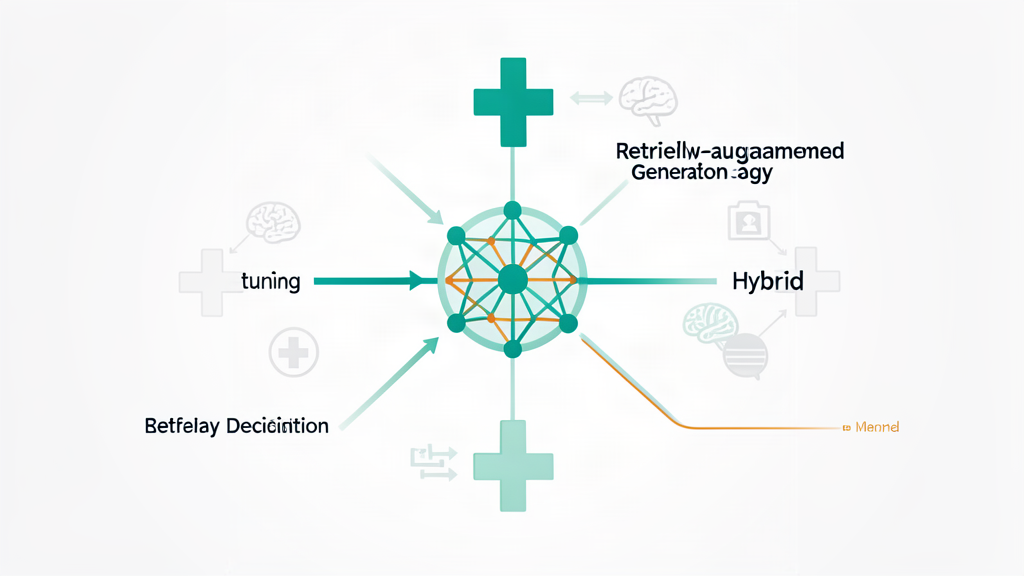
This systematic review, conducted in accordance with PRISMA 2020 guidelines, synthesizes evidence on three principal adaptation strategies:
1. Fine-Tuning (FT) / Parameter-Efficient Fine-Tuning (PEFT): Adjusting model weights for specific tasks.
2. Retrieval-Augmented Generation (RAG): Grounding responses in retrieved external documents (e.g., clinical guidelines).
3. Hybrid Approaches: Combining both methods to leverage the strengths of each.
For oncologists, this is particularly relevant as AI tools increasingly enter the clinic for triage, risk stratification, and treatment planning. Understanding which strategy aligns with specific clinical tasks is essential for evaluating the validity of AI-driven decision support.
Details
The review identified 1,890 records, with 35 meeting eligibility criteria. The studies spanned multiple specialties, including oncology, neurology, radiology, and cardiology. The following table summarizes the performance outcomes associated with each adaptation strategy as reported in the review.
| Adaptation Strategy | Primary Application | Reported Performance Metrics |
|---|---|---|
| Fine-Tuning / PEFT | Narrow classification tasks (e.g., cancer detection, MDD prediction) | AUC up to 0.912 for cancer detection; AUC 0.892 for MDD prediction PMID: 42753254 |
| RAG | Guideline-grounded reasoning and decision support | Guideline adherence increased from 71.1% to 92.1%; diagnostic accuracy increased from 78.9% to 94.7% PMID: 42753254 |
| Hybrid Approaches | Complex clinical workflows (stroke triage, dermatology, multimodal imaging, oncology) | External validation accuracies exceeding 90% PMID: 42753254 |
Strategic Alignment:
The authors suggest that strategy selection should be task-dependent:
- Fine-Tuning is best suited for narrow, well-defined classification tasks where the model needs to learn specific patterns from labeled data.
- RAG is superior for tasks requiring adherence to evolving clinical guidelines, as it allows the model to reference up-to-date external knowledge without retraining.
- Hybrid Systems generally achieved the strongest performance in complex, multimodal clinical workflows, suggesting that combining parametric knowledge with non-parametric retrieval offers the most robust solution for high-stakes oncology applications.
However, the review notes that RAG benefits were inconsistent across larger, reasoning-capable models, indicating that model architecture and scale interact with adaptation strategies in non-linear ways.
Limitations
⚠️ Critical Methodological ConcernsThe evidence base for LLM adaptation in clinical care is currently high-risk.
* Risk of Bias: 25 of 35 studies (71.4%) were judged as high risk of bias, 9 as unclear, and only 1 as low risk using the PROBAST+AI tool PMID: 42753254.
* Validation Gaps: Common concerns included inadequate external validation, lack of calibration assessment, and non-representative participant selection PMID: 42753254.
* Study Design: The majority of included studies were retrospective or benchmark-based, lacking prospective clinical trial data PMID: 42753254.
* Reporting: Insufficient reporting of analytical methods was a frequent issue, limiting reproducibility PMID: 42753254.
These limitations mean that the reported performance metrics (e.g., >90% accuracy) may not translate directly to real-world clinical settings. Clinicians should exercise extreme caution when interpreting these results as evidence of clinical efficacy.
Clinical Takeaway
When evaluating AI-based decision support tools for oncology, prioritize systems that employ hybrid adaptation strategies for complex multimodal tasks and verify that the tool has undergone prospective external validation with rigorous calibration assessment, rather than relying solely on retrospective benchmark performance.
Full Reference
Patel A, Khand Y, Vallamchetla SK, Li P, Tao C, Cheung J. Fine-Tuning, Retrieval-Augmented Generation, and Hybrid Adaptation of Language Models for Clinical Decision-Making in Health Care: Systematic Review. J Med Internet Res. 2026. PMID: 42753254 [DOI: 10.2196/104092]